Popular Articles
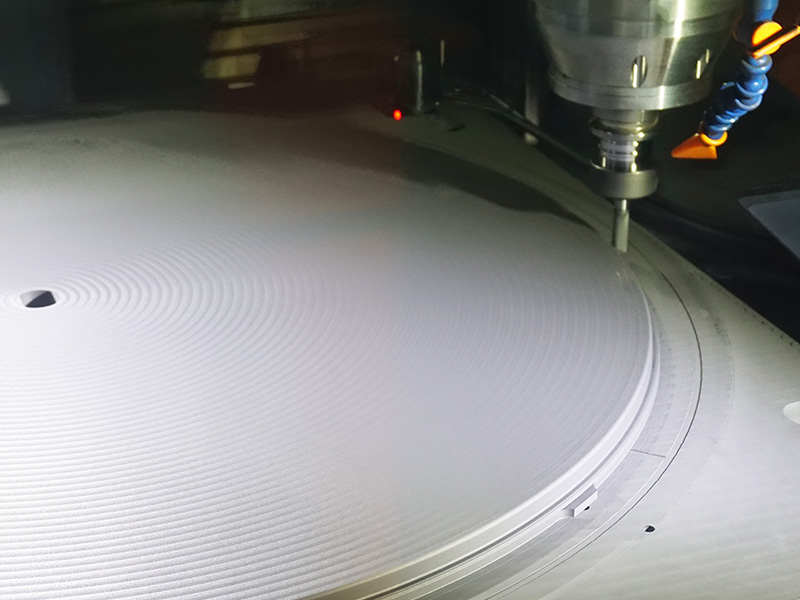
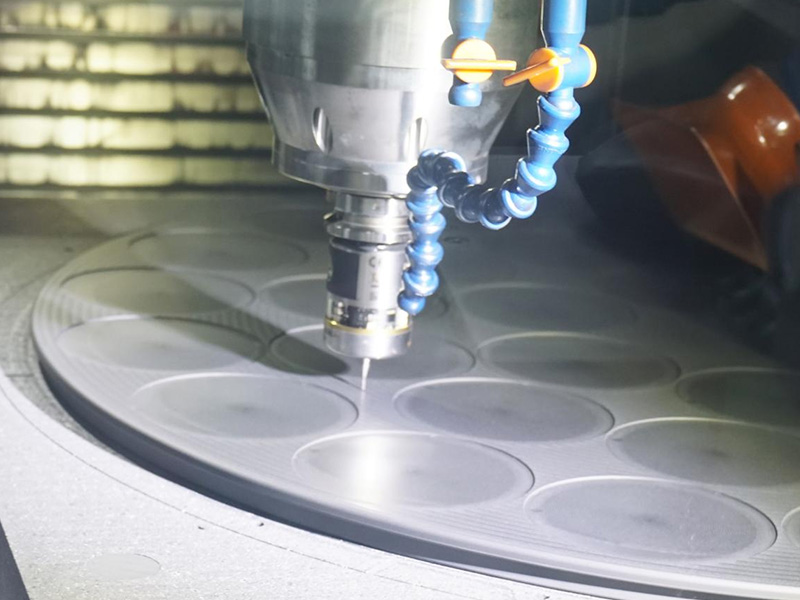
3 μm CNC Precision + Constant Climate Workshop: How to Deliver “Zero-Deformation” Substrates for CVD
2026-09-21

【Core Summary】
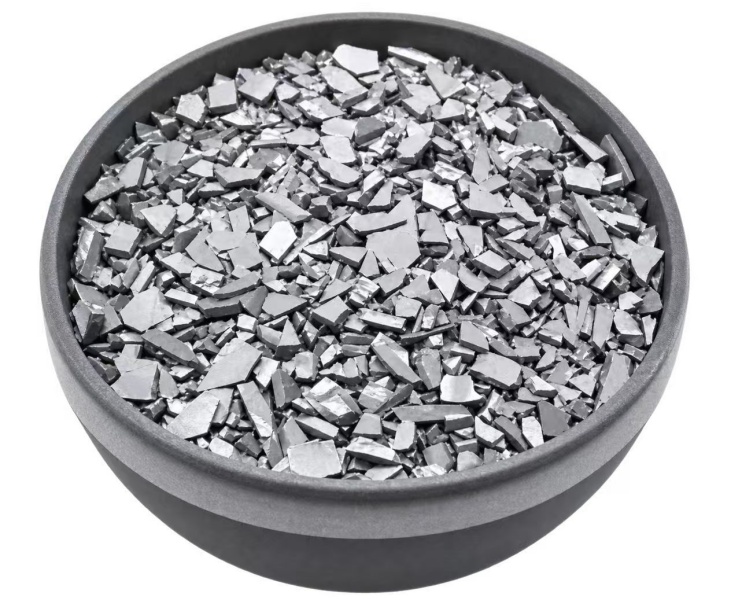
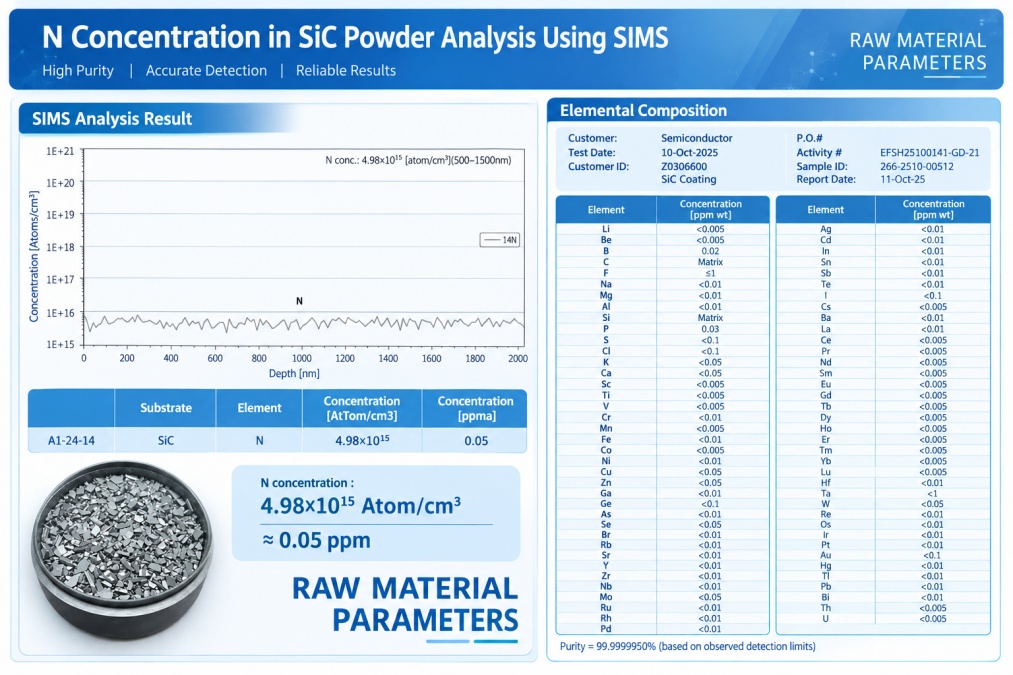
Traditional Acheson powder in SiC PVT often brings elevated nitrogen and metal impurities, fine powder that generates carbon dust, and unstable packing density and sublimation behavior. SemiXLab’s 7N-grade CVD-SiC source chunks, produced by a fluidized-bed CVD process, can reach nitrogen levels around 0.05 ppm, with larger and more controllable particle size and an Si/C ratio closer to 1:1. The result is lower carbon-dust risk, more uniform packing and heat transfer, and a more stable sublimation window—supporting fewer crystal defects and longer usable length.
This article expands the source-material theme from the Pillar page "CVD Coatings & Ultra-High-Purity Sources: System-Level Selection". For the overall framework, we recommend reading the pillar page first.
Core takeaway: Nitrogen impurities directly affect semi-insulating behavior and defect control; free carbon and fines readily introduce inclusions and disturb sublimation-interface stability. Source purity and morphology are upstream variables for crystal quality.
Many crystal-growth teams focus on temperature gradient, crucible design and seed. The source side often stays on old specifications. Only when the crystal shows high nitrogen, inclusions or growth-rate swings do they look back at the charge. Putting source specifications upstream usually saves several rounds of debugging.
Core takeaway: Nitrogen as low as ~0.05 ppm, very low metallic impurities, controllable chunk size, and Si/C closer to stoichiometry are the core differences of the CVD route versus Acheson powder.
Dimensions we commonly compare internally:
• Nitrogen content: CVD route can reach very low levels (~0.05 ppm), supporting semi-insulating and low-defect control
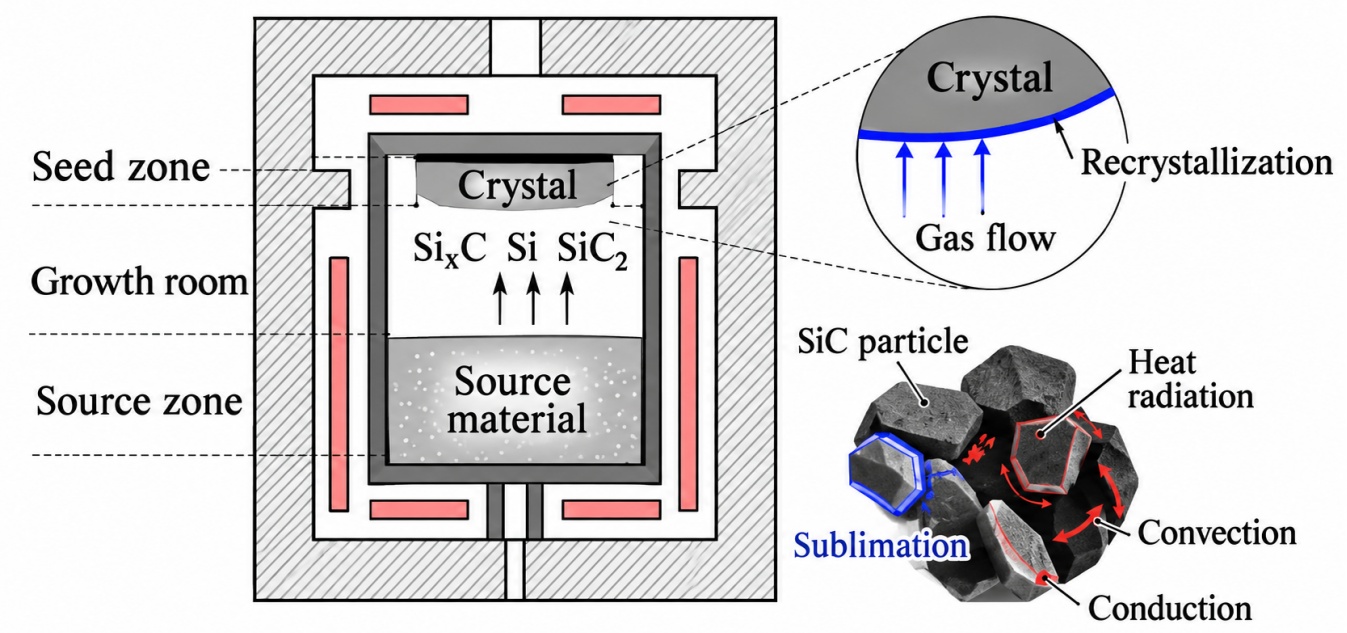
• Morphology and packing: chunks / larger particles raise bulk density and heat-transfer uniformity, and reduce carbon-dust risk from fines
• Si/C ratio: closer to 1:1, favoring stable sublimation and fewer defects from composition deviation
• Utilization and growth rate: under proper thermal-field matching, supports higher charge and a more stable growth window
For full source specifications and ordering information, see the High-Purity CVD-SiC Source / Crystal-Growth Feedstock page (New Technology product page).
Core takeaway: Even the best source will lose its advantage if the crucible, guides, coating and thermal field are mismatched. Source upgrades should be window-validated together with coated thermal-field components.
A typical situation we see on the customer side: the source is switched to 7N chunks, but the crucible coating stays on an old SiC scheme, or substrate dimensional batch variation is large—so improvement in sublimation interface and particles remains limited. Conversely, when CVD TaC (or matched SiC) thermal-field parts and 7N source are validated in the same process window, the data are usually cleaner.
For how to select coatings by temperature and atmosphere, see "CVD SiC vs TaC Coating Selection Guide"(Cluster page 1).
Engineering note: An SiC PVT crystal-growth customer reported that after switching to SemiXLab 7N-grade CVD-SiC chunks, nitrogen and carbon-dust performance improved clearly on most runs, and usable crystal length increased. On one 6-inch furnace, however, crystal nitrogen stayed repeatedly high over several consecutive runs—approaching or exceeding their semi-insulating target upper limit—while the same source batch and the same coated-crucible batch showed normal data on other tools. The customer initially suspected “7N batch variation” or “uneven chunk packing.”
Step 1: We checked GDMS and SIMS reports for that source batch—metallic impurities and nitrogen were within the stated range (N on the order of 0.05 ppm). The same batch performed normally on other furnaces, so the source itself was provisionally ruled out. Step 2: We compared thermal-field parts on the abnormal furnace versus normal ones—crucibles were all CVD TaC coated, same coating batch, with no significant difference in thickness or appearance. Step 3: Furnace maintenance and process records showed that this furnace had replaced the guide tube and part of the insulation in a recent major overhaul and had not re-calibrated the axial temperature gradient afterward. Follow-up measurement confirmed the temperature near the seed was about 15–20°C lower than on other tools, and the charge height was also slightly higher, pushing the sublimation interface and vapor transport path off the original process window.
After adjusting charge height and re-optimizing the temperature profile for the new thermal field, nitrogen on that furnace fell back in line with the others and crystal-quality swings disappeared. The lesson: higher source purity does not automatically mean “every run has low nitrogen.” Thermal-field gradient, charge geometry and coated-part condition must sit on the same troubleshooting checklist as the source. 7N chunks suppress upstream impurity variables; remaining variation is more likely to show up in thermal-field or operational differences—which actually helps locate the real cause faster, instead of first blaming the source batch.
Core takeaway: First run small-batch comparison of nitrogen, particle morphology, packing density and actual growth data; then lock long-term supply specs (including GDMS and chunk size range).
1. Define targets: polytype, size, acceptable N/metal upper limits, desired growth-rate range
2. Small-batch comparison: same furnace, same thermal-field parts, same metrology—Acheson powder vs 7N chunks
3. Lock specifications: chunk size range, bulk density, GDMS items, batch traceability
4. Link with thermal-field parts: coating scheme, substrate precision and refurbishment strategy evaluated together
A: Semi-insulating material is stricter on nitrogen, but even for conductive types, lower N and metal impurities plus more stable sublimation usually help defect control and batch consistency.
A: With a sensible size distribution, controllable chunks often give higher bulk density and fewer fines. The key is matching chunk size to the crucible and thermal-field design—not simply “bigger is better.”
A: Check GDMS/SIMS detection limits and actual values, and require batch traceability. SemiXLab can provide corresponding test data and accepts customer sample comparison.
If your PVT process is already limited by nitrogen, carbon dust or packing stability, a small-batch comparison with 7N chunks is worth running. If thermal-field parts are also under review, validate source and coating schemes in the same window.
For support from sample characterization to specification lock-in, see Sample Mapping service. If you have existing powder or failed crystals for comparison, you are also welcome to request free sample mapping or failure analysis.
In the next article we will cover purity verification, CTE matching and thermal-shock design—going deeper into coating reliability.
About the Author
SemiXLab MAE Team (Materials & Application Engineering)
Core team members come from the Chinese Academy of Sciences system and have long experience in carbon-based materials, CVD coatings and semiconductor thermal fields. The company currently operates 12 continuous production lines covering high-purity graphite machining, CVD SiC/TaC deposition and 7N-grade CVD-SiC source synthesis. We prefer to look at real parts, align on data and adjust parameters together with customers.
Website: https://www.semixlab.com/