Popular Articles
3 μm CNC Precision + Constant Climate Workshop: How to Deliver “Zero-Deformation” Substrates for CVD
2026-09-21

【Core Summary】
The most common mistake in coating selection is treating “it can work” as “it is the best fit.” At Semixlab we see this often: CVD SiC offers high thermal conductivity, a mature process and controllable cost—it is the workhorse for MOCVD, epitaxy and RTP. CVD TaC has a higher melting point and is more stable under strong reducing atmospheres and ultra-high temperatures, making it better suited to SiC PVT and similar extreme conditions. This article clarifies the real boundaries of the two options across temperature window, atmosphere compatibility and lifetime-adjusted cost, and provides a decision path you can use directly.
For full product specifications and application scenarios, see our CVD Coating Solutions page.
Core takeaway: CVD SiC is typically reliable in the roughly 1400–1800°C range (depending on atmosphere and thickness). TaC shows clear advantages above 2000°C, especially near or above 2200°C in PVT environments.
| Parameter | CVD SiC Coating | CVD TaC Coating |
| Density | 3.21 g/cm³ | 14.3 g/cm³ |
| Hardness | 2500 HV | 2000 HK |
| Purity | 99.99995% | High purity |
| Thermal Cond. | 300 W·m⁻¹·K⁻¹ | 9–22 W/(m·K) |
| CTE | 4.5×10⁻⁶ /K | 6.3×10⁻⁶ /K |
| Max Temp. | ~2100°C (subl. 2700°C) | <2500°C |
| Typical Thickness | 30–300 μm | 35±10 μm (≥20 μm) |
| Key Advantages | High thermal conductivity, mature process, cost-effective | Ultra-high density, extreme temperature, chemical stability |
| Typical Applications | SiC/GaN epi, MOCVD, RTP, diffusion, high-temp heaters (mainstream) | SiC PVT crystal growth, ultra-high-temp epi rings, thermal fields (preferred) |
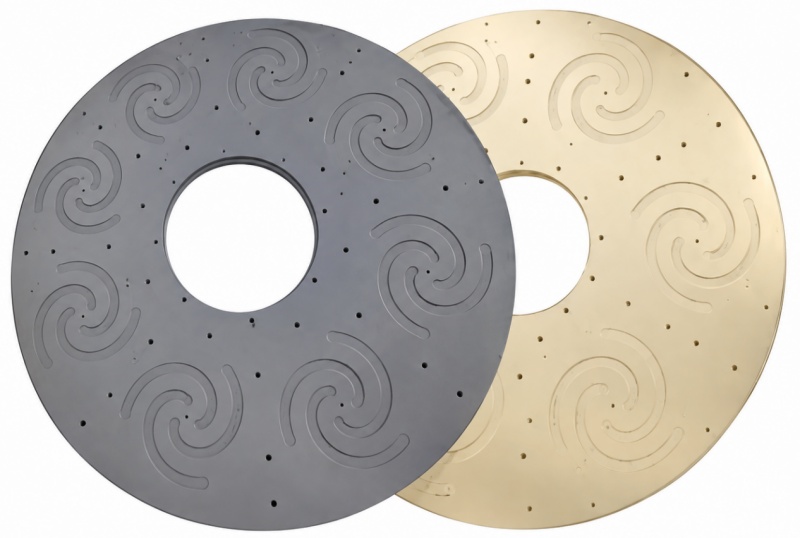
A common field situation: process engineers keep ordering the same SiC coating they have always used. Temperature or atmosphere is raised, and the coating starts to evaporate, generate particles or fail early. The opposite also happens—someone switches everything to TaC at once, cost jumps, yet the process window never really required TaC.
From Semixlab internal tests and customer feedback: write down the maximum process temperature and atmosphere first, then choose the material. That is cheaper and more stable than locking the material first and forcing the window later.
Core takeaway: SiC is mature in oxidizing and most mid-to-high temperature atmospheres. Under strong reducing conditions, long high-hydrogen or ammonia exposure, and ultra-high-temperature metal vapors, TaC’s chemical stability and low contamination risk stand out more clearly.
In typical MOCVD H₂/NH₃ mixtures, CVD SiC coatings already have extensive mature use. Once the process moves into SiC PVT—high hydrogen, high silicon vapor, long high-temperature soaks—the coating’s own vapor pressure and impurity release become yield variables. TaC’s lower vapor pressure and higher chemical inertness often help keep particles and metal contamination down.
If your process is mainly epitaxy or MOCVD, start with the overall framework on the Pillar page “CVD Coatings & Ultra-High-Purity Sources: System-Level Selection”, then come back here for the detailed comparison.
Core takeaway: Nominal unit price is not the final cost. Only after converting to cost of ownership (stable running hours × output per run) can SiC and TaC be compared fairly.
Many purchasing colleagues’ first reaction is that TaC is more expensive. That is true on the price list. But once you factor in rework from rising particles, downtime from early replacement, and inventory turns from short lifetime, the conclusion sometimes flips. On large, high-value epitaxy or crystal-growth tools, a few hundred extra hours of lifetime can change whole-tool output significantly.
For detailed TaC product parameters and application scenarios, see the CVD TaC Coating product page.
A 6-inch SiC epitaxy customer had long used standard CVD SiC coatings on MOCVD susceptors. At a stable process temperature around 1550°C, particle levels and lifetime were normal. To raise capacity they pushed part of the recipe window close to 1800°C and extended the high-hydrogen steps. After about three months, local coating thinning appeared, particle counts roughly doubled, and effective lifetime fell from the design target of ~800 hours to under 500 hours. Replacement frequency rose sharply.
The SemiXLab team reviewed the data together with the customer and did not switch the entire fleet to TaC (that would have driven cost up significantly). Instead we took two steps: (1) for tools still running in the original window, we optimized SiC coating thickness and substrate CTE match; (2) for tools with the higher-temperature, longer-hydrogen process, we ran a small-batch comparison with CVD TaC coated susceptors. After a full evaluation cycle, particle levels on the high-temperature tools returned to the previous range, lifetime recovered near the design value, and cost of ownership was more controllable than frequent SiC part changes. Mid-temperature tools stayed on the optimized SiC solution, avoiding unnecessary cost increase.
This example shows that selection is not a binary “SiC or TaC” choice. It is stratification by real temperature–atmosphere windows. Write down the maximum temperature and atmosphere first, then use small-batch data to decide which tools justify TaC. That is usually cheaper and more stable than a one-size-fits-all switch.
Core takeaway: Prefer SiC for MOCVD / epitaxy / RTP. Prefer TaC for SiC PVT and ultra-high-temperature aggressive corrosion. In the grey zone, validate with small batches against real temperature, atmosphere and lifetime targets.
• Long-term max temperature <1800°C, atmosphere mainly H₂/NH₃/typical epi gases → prefer CVD SiC
• Max temperature often >2000°C, or long strong reducing / metal vapor exposure → prioritize evaluating CVD TaC
• Grey zone → run small-batch comparison (same tool, same process, same metrology) and decide on particle, lifetime and metal-impurity data
Selection is not one-and-done. When the process window is raised, the existing coating approach must be re-evaluated. This is the point we most often remind customers during regular reviews.
A: Not necessarily. First check whether the new temperature stays above the reliable range of the current coating for long periods, and whether the atmosphere has also become more aggressive. In many cases, adjusting thickness, substrate match or process parameters can extend life without a full switch.
A: No. TaC has clear advantages in ultra-high temperature and certain corrosive environments. For mid-to-high temperature epitaxy, SiC’s thermal conductivity, process maturity and cost structure remain the mainstream choice. Fit matters more than “premium.”
A: The most effective way is a same-condition small-batch comparison: same substrate precision, same inspection items (particles, metal impurities, post thermal-cycle morphology), run for a meaningful fraction of design lifetime, then look at the data. We support sample mapping and small-batch validation.
If the temperature and atmosphere windows are already clear, use the decision path above for a first judgment. If you are still in the grey zone, we recommend a sample-level comparison first.
For end-to-end support from material selection and CTE matching to small-batch validation, see our Materials & Design service page. If you have failed parts or want a comparison test, you are also welcome to request free sample mapping.
In the next article we will focus on how 7N-grade CVD-SiC source material improves SiC PVT crystal growth and how it should be matched with coated thermal-field components.
About the Author
SemiXLab MAE Team (Materials & Application Engineering)
Core team members come from the Chinese Academy of Sciences system and have long experience in carbon-based materials, CVD coatings and semiconductor thermal fields. The company currently operates 12 continuous production lines covering high-purity graphite machining, CVD SiC/TaC deposition and 7N-grade CVD-SiC source synthesis. We prefer to look at real parts, align on data and adjust parameters together with customers.
Website: https://www.semixlab.com/